
Have you noticed light spotting before your expected period and are wondering whether it is implantation bleeding or the start of your menstrual cycle? This is one of the most common questions women ask when trying to conceive or when an unexpected spot of blood appears.
Understanding the difference between implantation bleeding vs. period can help reduce confusion and anxiety. Although both involve vaginal bleeding, they differ in timing, color, flow, duration, and accompanying symptoms. In this comprehensive guide, we will explain everything you need to know about implantation bleeding, how it differs from a normal period, early pregnancy symptoms, and when you should take a pregnancy test.
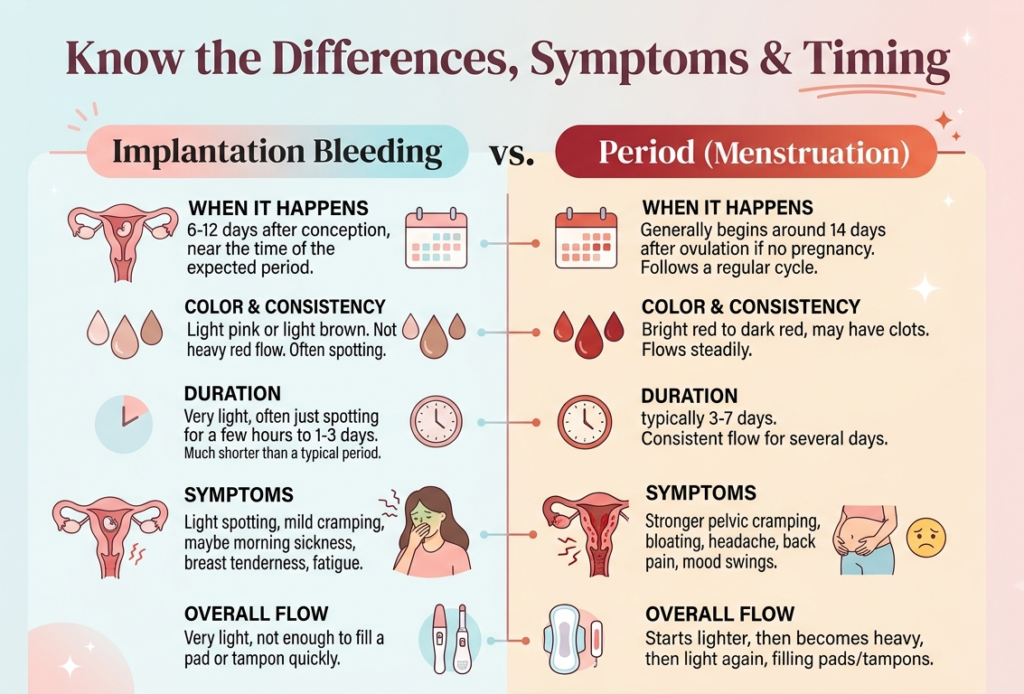
What Is Implantation Bleeding?
Implantation bleeding is light spotting that may occur when a fertilized egg attaches itself to the lining of the uterus. This process usually happens about 6 to 12 days after ovulation. During implantation, tiny blood vessels in the uterine lining can break, causing very light bleeding or spotting. Not every pregnant woman experiences implantation bleeding. In fact, many pregnancies occur without any spotting at all.
What Is a Menstrual Period?
A menstrual period is the monthly shedding of the uterine lining when pregnancy does not occur. During a menstrual cycle, hormones prepare the uterus for pregnancy. If fertilization does not happen, hormone levels drop and the uterine lining breaks down and exits the body through vaginal bleeding. Periods usually last between 3 and 7 days and involve a much heavier flow than implantation bleeding.
Implantation Bleeding vs. Period: Quick Comparison
Implantation bleeding vs. period chart is given as below:
| Feature | Implantation Bleeding | Menstrual Period |
| Timing | 6 to 12 days after ovulation | Around 14 days after ovulation |
| Color | Light pink, brown, or light red | Bright red to dark red |
| Flow | Very light spotting | Moderate to heavy |
| Duration | A few hours to 2 days | 3 to 7 days |
| Clots | Rare | Common |
| Cramping | Mild | Mild to severe |
| Pads or Tampons | Usually unnecessary | Usually required |
| Pregnancy | May indicate early pregnancy | Usually means pregnancy did not occur |
Implantation Bleeding Look
Many women describe implantation bleeding as:
- A few drops of blood
- Pink spotting
- Brown discharge
- Light rust-colored spotting
- Very light red spotting
Unlike a period, implantation bleeding usually does not become heavier. If you need to change a pad every few hours, it is much more likely to be your menstrual period.
Implantation Bleeding Color
Color is one of the biggest clues. Common implantation bleeding colors include:
- Light pink
- Brown
- Light rust
- Very light red
Menstrual blood is often:
- Bright red
- Dark red
- Burgundy
- Dark brown toward the end of the period
Flow Differences
Their differences is given as below:
Implantation Bleeding
- Very light
- Spotting only
- Does not soak a pad
- Often visible only when wiping
Menstrual Period
- Gets progressively heavier
- May require pads, tampons, or menstrual cups
- Can include blood clots
- Lasts several days
Duration
Implantation bleeding usually lasts:
- A few hours
- One day
- Up to two days
A menstrual period generally lasts:
- Three days
- Four days
- Five days
- Up to seven days
If bleeding continues beyond two days and becomes heavier, it is more likely to be your period.
Implantation Bleeding Timing
Timing is one of the easiest ways to tell the difference. A typical cycle looks like this:
- Day 1: Period starts
- Day 14: Ovulation
- Days 20 to 26: Implantation may occur
- Day 28: Expected period
Implantation bleeding usually appears a few days before your expected period. However, every menstrual cycle is different, especially if you have irregular periods.
Implantation Bleeding Symptoms
Women may notice:
- Light spotting
- Mild cramping
- Breast tenderness
- Fatigue
- Bloating
- Increased body temperature
- Mild pelvic discomfort
Some women experience no symptoms at all.
Period Symptoms
A menstrual period commonly includes:
- Moderate or heavy bleeding
- Stronger cramps
- Lower back pain
- Headaches
- Acne breakouts
- Mood swings
- Fatigue
- Bloating
Implantation Bleeding and Cramps
Yes. Implantation cramps are generally:
- Mild
- Short lasting
- Less painful than menstrual cramps
- Felt as light pulling or tingling in the lower abdomen
Period cramps are usually stronger because the uterus contracts to shed its lining.
Experience of Implantation Bleeding on person to person
No. Research suggests only a portion of pregnant women notice implantation bleeding. Many healthy pregnancies occur without any spotting. Therefore, not having implantation bleeding does not mean you are not pregnant.
Implantation Bleeding as a Mistaken for a Period
Absolutely. Many women initially believe implantation bleeding is an early or unusually light period. This is especially common when spotting occurs close to the expected start date of menstruation. The key differences are usually:
- Lighter flow
- Shorter duration
- No heavy bleeding
- No large clots
Implantation Bleeding vs. Early Pregnancy Spotting
Spotting during early pregnancy is not always implantation bleeding. Other possible causes include:
- Cervical irritation
- Hormonal changes
- Sexual intercourse
- Medical examinations
- Certain pregnancy complications
If bleeding becomes heavy or is accompanied by severe pain, seek medical attention immediately.
Take a Pregnancy Test
If you suspect implantation bleeding, wait until:
- The first day of your missed period
- Or about 10 to 14 days after ovulation
Testing too early may produce a false negative because pregnancy hormone (hCG) levels may still be too low. For the most accurate result:
- Use first morning urine
- Follow the instructions carefully
- Repeat the test after 48 hours if negative but your period still has not started
Implantation bleeding weight:
No. Heavy bleeding is generally not considered implantation bleeding. If you experience:
- Heavy bleeding
- Large clots
- Severe abdominal pain
- Dizziness
- Shoulder pain
- Fainting
Seek immediate medical care.
Common Myths about Implantation Bleeding
Some myths about implantation bleeding is given as below:
Myth 1: Every pregnant woman has implantation bleeding.
False. Many never experience it.
Myth 2: Implantation bleeding is always pink.
False. It may also be brown or light red.
Myth 3: Implantation bleeding lasts a week.
False. It usually lasts only a few hours to two days.
Myth 4: Heavy bleeding can be implantation bleeding.
False. Heavy bleeding is more consistent with menstruation or another medical condition.
See a Doctor
Contact a healthcare provider if you experience:
- Heavy bleeding
- Severe cramps
- Fever
- Foul smelling discharge
- Positive pregnancy test with significant bleeding
- Bleeding after confirmed pregnancy
Prompt evaluation can help rule out complications and ensure appropriate care.
Final Thoughts
Distinguishing implantation bleeding vs. period can be challenging because the symptoms often overlap. However, paying attention to the timing, color, flow, duration, and associated symptoms can provide helpful clues.
Implantation bleeding is typically light, short lived, and occurs before your expected period, while menstrual bleeding is heavier, lasts several days, and is part of your regular cycle. If you believe you may be pregnant, wait until after your missed period to take a home pregnancy test. If you experience heavy bleeding, severe pain, or any concerning symptoms, consult a healthcare professional promptly for evaluation.
FAQs:
- Can implantation bleeding fill a pad?
No. Implantation bleeding is usually too light to soak a pad.
- Is brown discharge implantation bleeding?
Yes. Brown spotting is one of the most common signs of implantation bleeding.
- Can implantation bleeding have clots?
It is uncommon. Clots are much more typical during a menstrual period.
- How many days after implantation can I test positive?
Most women can obtain an accurate pregnancy test after a missed period or around 10 to 14 days after ovulation.
- Can implantation bleeding happen after a missed period?
It is uncommon. Implantation generally occurs before the expected menstrual period.
- Can implantation bleeding occur without cramps?
Yes. Many women experience spotting without any cramping.
