
Watching your baby grow is one of the most exciting experiences for every parent. During the first year, babies develop at an incredible pace. Every week brings new changes in physical growth, brain development, communication skills, sleep patterns, and emotional bonding.
Understanding baby development by week helps parents know what to expect while recognizing important milestones. Although every baby grows at their own pace, knowing the general timeline can help you support healthy development and identify when it may be helpful to speak with your pediatrician. In this complete week by week baby development guide, you will learn about physical growth, cognitive development, feeding milestones, sleep changes, emotional development, and practical parenting tips throughout your baby’s first year.
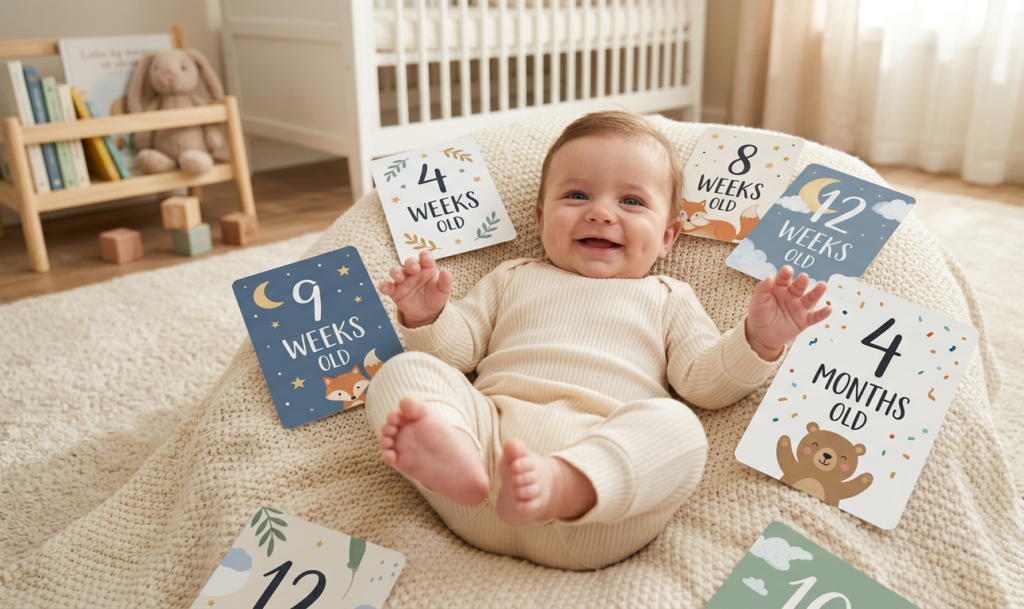
Why Understanding Baby Development by Week Matters
Every week of your baby’s first year contributes to lifelong learning and development. Tracking weekly milestones allows parents to:
- Understand normal developmental changes
- Encourage healthy brain development
- Support physical growth
- Improve feeding routines
- Build stronger emotional bonds
- Monitor developmental milestones
- Recognize possible developmental delays early
- Gain confidence as new parents
Remember that every baby develops differently. Some babies walk earlier, while others may begin talking sooner. Small differences are perfectly normal.
Baby Development by Week Overview Table
Baby development by week is given as below:
| Baby Age | Physical Development | Cognitive Development | Sleep | Feeding |
| Week 1-2 | Reflexes, stretching | Recognizes voices | 16-18 hours | Breast milk or formula |
| Week 3-4 | Better head movement | Follows faces | 15-17 hours | Frequent feeding |
| Week 5-8 | Stronger muscles | Social smiling begins | 15-16 hours | Cluster feeding common |
| Week 9-12 | Holds head steady | Tracks objects | Longer night sleep | Improved feeding |
| Week 13-16 | Rolls over | Explores hands | Predictable naps | Increased appetite |
| Week 17-20 | Sits with support | Recognizes parents | 14-15 hours | May prepare for solids |
| Week 21-24 | Better coordination | Responds to name | Longer naps | Solids may begin |
| Week 25-32 | Crawling attempts | Problem solving begins | 13-15 hours | Finger foods later |
| Week 33-40 | Pulls to stand | Understands simple words | Consistent routine | Three meals developing |
| Week 41-52 | First steps possible | Says first words | 12-14 hours | Family foods gradually |
Week 1 to Week 2: Welcome to the World
The first two weeks are focused on adjustment. Your newborn is adapting to life outside the womb.
Physical Development
During this stage your baby will:
- Display newborn reflexes
- Keep hands tightly closed
- Sleep most of the day
- Lose a small amount of birth weight before gaining it back
- Make jerky arm and leg movements
Brain Development
Your baby’s brain is already learning by:
- Recognizing your voice
- Responding to familiar sounds
- Looking at faces
- Learning feeding routines
Feeding
- Breastfed babies usually eat every two to three hours.
- Formula-fed babies generally eat every three to four hours.
- Frequent feeding supports healthy growth.
Sleep
Expect your newborn to sleep between 16 and 18 hours each day.
Week 3 to Week 4: Becoming More Alert
By the end of the first month, your baby begins spending more time awake.
Developmental Milestones
Your baby may:
- Lift their head briefly during tummy time
- Focus on faces
- Begin making eye contact
- Respond to bright lights
- Become calmer when hearing your voice
Parent Tip
Practice tummy time for a few minutes several times each day. This helps strengthen neck and shoulder muscles.
Week 5 to Week 8: The First Social Smile
One of the most memorable milestones often happens during this period.
Physical Growth
Your baby is becoming stronger every day. They may:
- Lift their head higher
- Move arms more smoothly
- Kick with more strength
Social Development
Many babies begin:
- Smiling intentionally
- Enjoying face-to-face interaction
- Recognizing parents
- Responding to gentle voices
Brain Development
Connections inside the brain are forming rapidly. Talking, singing, and reading support language development.
Week 9 to Week 12: Exploring the World
Your baby becomes increasingly curious.
Milestones
Many babies can:
- Hold their head steady
- Follow moving toys
- Laugh
- Reach toward objects
- Enjoy tummy time
Sleep Changes
Some babies begin sleeping for longer stretches at night. Night waking is still completely normal.
Week 13 to Week 16: Rolling and Discovering Hands
Around four months, development speeds up dramatically.
Physical Skills
Your baby may:
- Roll from tummy to back
- Grab toys
- Bring hands to mouth
- Push up during tummy time
Cognitive Growth
Babies begin understanding cause and effect. For example, shaking a toy creates sound.
Week 17 to Week 20: Building Strength
Your baby is becoming much more active.
Development
You may notice:
- Sitting with support
- Stronger leg muscles
- Better hand coordination
- Increased curiosity
Emotional Development
Babies begin showing excitement when parents enter the room. Attachment continues growing stronger.
Week 21 to Week 24: Ready for New Experiences
Many babies begin trying solid foods around six months after discussing readiness with their pediatrician.
Signs Your Baby May Be Ready
- Good head control
- Sits with support
- Shows interest in food
- Opens mouth for spoon
- Can swallow purees
Common First Foods
- Iron-fortified cereal
- Mashed banana
- Sweet potato
- Avocado
- Pureed carrots
Continue breast milk or formula as the primary source of nutrition.
Week 25 to Week 32: On the Move
This period is full of movement.
Physical Development
Your baby may:
- Crawl
- Sit independently
- Transfer toys between hands
- Pull up on furniture
- Stand with support
Cognitive Development
Babies begin solving simple problems. They enjoy:
- Peekaboo
- Stacking cups
- Looking for hidden toys
Week 33 to Week 40: Communication Grows
Language development accelerates.
Communication Milestones
Many babies begin:
- Babbling repeatedly
- Understanding simple words
- Responding to their name
- Waving goodbye
- Clapping hands
Fine Motor Skills
Improved finger control allows babies to:
- Pick up small foods
- Turn pages
- Point at objects
Week 41 to Week 52: Almost a Toddler
Your baby’s first birthday is approaching.
Physical Milestones
Many babies:
- Stand alone
- Take first steps
- Cruise along furniture
- Squat to pick up toys
Language Development
Some babies begin saying:
- Mama
- Dada
- Bye
- More
- Ball
Every child develops speech differently.
Baby Development Milestones by Category
Baby development milestones is given as below:
Physical Development
During the first year babies gradually learn to:
- Lift their head
- Roll over
- Sit
- Crawl
- Pull to stand
- Walk
Cognitive Development
Brain development includes:
- Learning through play
- Recognizing faces
- Understanding routines
- Solving simple problems
- Remembering familiar people
Social Development
Babies learn to:
- Smile
- Laugh
- Show affection
- Recognize family
- Develop stranger anxiety
Language Development
Communication grows from:
- Crying
- Cooing
- Babbling
- Gestures
- First words
Feeding Guide during the First Year
Feeding guide during the first year is given as below:
| Age | Feeding Recommendation |
| 0-6 months | Breast milk or formula only |
| Around 6 months | Begin solid foods if developmentally ready |
| 6-8 months | Purees and soft foods |
| 8-10 months | Mashed foods and finger foods |
| 10-12 months | More family foods with safe textures |
Always introduce new foods one at a time and watch for allergic reactions.
Sleep Development by Age
| Age | Average Daily Sleep |
| Newborn | 16-18 hours |
| 2 Months | 15-16 hours |
| 4 Months | 14-16 hours |
| 6 Months | 14-15 hours |
| 9 Months | 13-15 hours |
| 12 Months | 12-14 hours |
Every baby has unique sleep needs.
Activities That Support Healthy Baby Development
Simple daily activities encourage learning. Try:
- Reading books
- Singing songs
- Talking throughout the day
- Tummy time
- Playing peekaboo
- Looking at picture books
- Sensory play
- Outdoor walks
- Safe floor play
- Naming everyday objects
These experiences strengthen brain development and language skills.
Signs to Contact Your Pediatrician
While babies develop at different speeds, consult your pediatrician if your baby:
- Does not respond to sounds
- Rarely makes eye contact
- Has difficulty feeding
- Shows very poor muscle tone
- Does not smile by around two months
- Cannot hold their head up by around four months
- Is not sitting with support by around six months
- Shows no interest in interacting with people
Early evaluation can provide reassurance or identify areas where extra support may help.
Tips for Supporting Healthy Development
- Respond to your baby’s cues with warmth and consistency.
- Offer plenty of supervised floor time to encourage movement.
- Read aloud every day, even during infancy.
- Maintain regular well-baby checkups and vaccinations.
- Provide a safe environment for exploration.
- Limit screen exposure during the first years of life.
- Encourage play that stimulates all the senses.
Conclusion
The first year of your baby’s life is filled with remarkable growth and unforgettable milestones. From the first smile to the first steps, each week brings exciting changes in physical strength, brain development, communication, and emotional connection.
By understanding baby development by week, you can better support your child’s learning, celebrate every achievement, and feel more confident in your parenting journey. Remember that every baby is unique. Milestones serve as helpful guides rather than strict deadlines. Focus on providing love, responsive care, good nutrition, safe sleep, and opportunities for play, and your baby will have a strong foundation for healthy growth and lifelong learning.
FAQs:
- What is the most important baby milestone in the first year?
There is no single most important milestone. Smiling, rolling over, sitting, crawling, standing, and first words all reflect healthy development in different areas.
- Can a baby skip crawling?
Yes. Some babies never crawl in the traditional sense and instead scoot, roll, or move directly to pulling up and walking.
- How can I help my baby’s brain development?
Talk, read, sing, play, cuddle, and respond to your baby’s needs. These simple interactions build strong brain connections.
- Should I compare my baby’s milestones with other babies?
No. Every child develops at a unique pace. Focus on your baby’s progress and discuss any concerns with your pediatrician.
- When should my baby start eating solid foods?
Most babies are ready around six months when they have good head control, can sit with support, and show interest in food. Consult your pediatrician before introducing solids.
