
If you have ever felt that midafternoon slump where your energy crashes, your focus disappears, and even simple tasks feel heavy, you are not alone. That dip in energy is real, and it happens to millions of people every day. The good news is that there is a simple, science backed solution that can help you reset your brain, improve productivity, and boost your mood in a short amount of time. That solution is the power nap.
In this detailed guide, we will break down everything you need to know about power naps, including what they are, the real benefits of power naps, the best time to nap, how long your nap should be, and practical tips to make your naps more effective. Whether you are a student, a professional, or someone trying to improve daily energy levels, this guide will help you master the art of napping.
What Is a Power Nap?
A power nap is a short sleep session that typically lasts between 10 and 30 minutes. Unlike long naps that can leave you feeling groggy, a properly timed power nap is designed to refresh your mind without entering deep sleep stages.
The goal of a power nap is simple: Recharge your brain, improve alertness, boost cognitive performance and increase energy levels. Power naps are often used by high performers, including entrepreneurs, athletes, and even pilots, to stay sharp and maintain peak performance throughout the day.
Why Do We Feel Sleepy During the Day?
Before diving into the benefits of power naps, it helps to understand why we feel tired in the first place. There are two main reasons:
- Circadian Rhythm: Your body has an internal clock that regulates sleep and wake cycles. This rhythm naturally dips in the early afternoon, usually between 1 PM and 3 PM. That is why many people feel sleepy after lunch.
- Sleep Pressure: The longer you stay awake, the more your body builds up sleep pressure. This pressure creates that heavy, tired feeling. A short nap can reduce this pressure and restore mental clarity.
Top Power Nap Benefits
Let’s explore the most important benefits of power naps that make them so effective.
1. Boosts Energy Instantly
One of the biggest advantages of a power nap is the immediate energy boost. Even a 10 to 20 minute nap can help you feel refreshed and ready to take on the rest of your day. This is especially helpful if you work long hours, study for extended periods and feel drained in the afternoon.
2. Improves Focus and Concentration
Short naps have been shown to improve attention span and mental performance. If you find yourself losing focus during work or study sessions, a quick nap can help sharpen your mind. This is why power naps are often recommended for students preparing for exams, professionals handling complex tasks and people working in high stress environments.
3. Enhances Memory and Learning
Power naps can improve memory retention and learning ability. When you nap, your brain processes and organizes information, making it easier to recall later. This is particularly useful for studying new material, learning new skills and improving problem solving abilities.
4. Reduces Stress and Improves Mood
A short nap can help lower stress levels and improve emotional balance. When you are well rested, you are less likely to feel irritable or overwhelmed. Power naps can improve mood, reduce anxiety and increase patience and emotional control.
5. Increases Productivity
Instead of pushing through fatigue and producing low quality work, a quick nap can help you reset and perform better. Many people notice that after a power nap, they can complete tasks faster and with better accuracy.
6. Supports Heart Health
Some studies suggest that short naps may help reduce stress on the heart and improve overall cardiovascular health. While more research is ongoing, the connection between rest and heart health is promising.
7. Boosts Creativity
When your brain is rested, it can think more clearly and creatively. Power naps can help generate new ideas and improve problem solving skills.
Ideal Power Nap Length
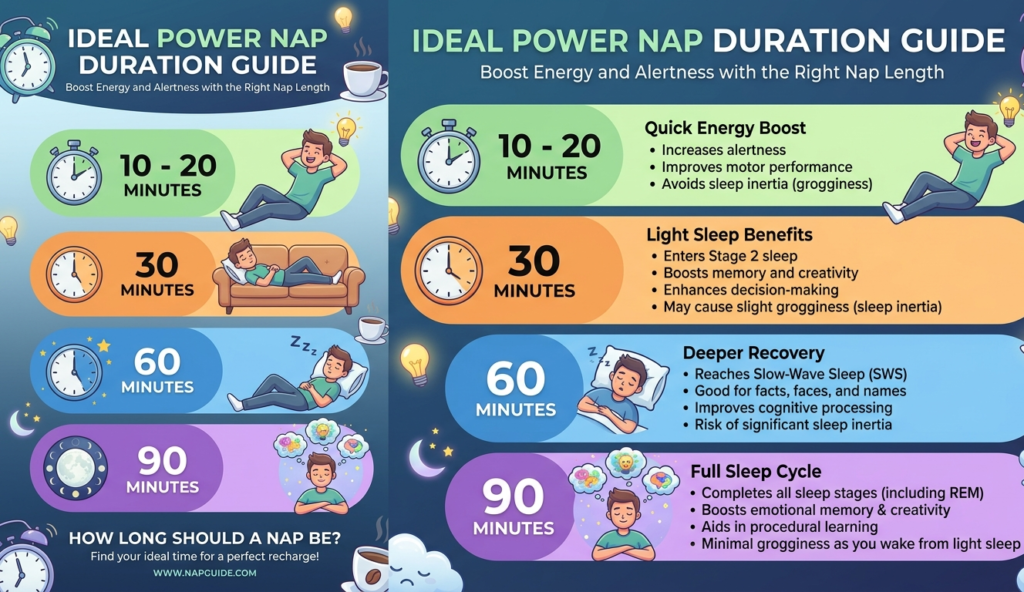
One of the most important factors in effective napping is timing. Not all naps are equal. Here is a breakdown:
- 10 to 20 Minutes (Best for Most People): Quick refresh, boosts alertness, no grogginess and ideal for work breaks
- 20 to 30 Minutes: Improves focus, memory and slight risk of grogginess if extended
- 60 minutes: Helps with deep memory processing and ay cause sleep inertia (groggy feeling)
- 90 minutes: Full sleep cycle, improves creativity and emotional memory and requires more time commitment
For daily use, the 10 to 20 minute power nap is considered the most effective and practical.
Best Time to Take a Power Nap
Timing matters just as much as duration.
Optimal Time: Early Afternoon: The best time for a power nap is between 1 PM and 3 PM. This aligns with your natural circadian rhythm and helps you avoid interfering with nighttime sleep.
Avoid Late Afternoon Naps: Napping too late in the day can disrupt your sleep at night, make it harder to fall asleep and affect sleep quality.
How to Do a Power Nap the Right Way
Taking a nap sounds simple, but doing it correctly makes all the difference.
1. Keep It Short
Set an alarm for 10 to 20 minutes. This prevents you from entering deep sleep and waking up groggy.
2. Find a Quiet and Comfortable Space
Choose a place where you can relax without interruptions. This could be:
- A bedroom
- A quiet office space
- Even your car if needed
3. Reduce Light Exposure
Dim lighting helps your body relax faster. You can use:
- Eye masks
- Curtains
- A dark room
4. Use a Timer
Always set an alarm so your nap does not extend too long.
5. Try the Coffee Nap Trick
This is a popular technique:
- Drink a cup of coffee
- Immediately take a 15 minute nap
Caffeine takes about 20 minutes to kick in, so you wake up feeling extra alert.
6. Relax Your Body
You do not need to fall into deep sleep. Even light rest can provide benefits. Focus on:
- Slow breathing
- Releasing tension
- Staying still
7. Be Consistent
Try to nap at the same time each day if possible. Your body adapts to routine.
Common Power Nap Mistakes to Avoid
Even though power naps are simple, many people make mistakes that reduce their effectiveness.
1. Napping Too Long: Long naps can lead to sleep inertia, making you feel worse instead of better.
2. Napping Too Late: Late naps can interfere with nighttime sleep patterns.
3. Skipping Night Sleep: Power naps are not a replacement for proper sleep. You still need 7 to 9 hours of sleep at night.
4. Napping in Noisy Environments: Distractions can prevent you from relaxing properly.
5. Expecting Immediate Sleep: It is okay if you do not fall fully asleep. Resting is still beneficial.
Who Should Take Power Naps?
Power naps can benefit almost everyone, but they are especially useful for:
- Students: Improves learning and memory and helps manage study fatigue
- Office Workers: Boosts productivity and reduces burnout
- Shift Workers: Helps manage irregular schedules and improves alertness
- Athletes: Enhances recovery and improves performance
- Busy Professionals: Maintains energy throughout long workdays
Are Power Naps Safe for Everyone?
Power naps are generally safe, but some people should be cautious. You may need to limit naps if you have insomnia, struggle to sleep at night or have certain sleep disorders. If naps interfere with your nighttime sleep, consider shortening them or skipping them altogether.
Power Nap and Productivity: A Smart Strategy
Many successful individuals and companies recognize the value of power naps. Some workplaces even provide nap pods or quiet spaces for employees. Instead of viewing naps as laziness, they are now seen as a productivity tool. A well timed nap can replace hours of low quality work, improve decision making and increase efficiency.
Power Nap Statistics and Research Insights
The following table highlights key data and findings related to power naps and their impact on energy, focus, memory, and productivity.
| Power Nap Statistic | Research Insight | Why It Matters |
| 10 to 20 minutes | Considered the ideal power nap duration | Provides quick refreshment without sleep grogginess |
| 34% improvement in performance | Short naps can significantly improve task performance | Helps boost work efficiency and concentration |
| 54% increase in alertness | Studies show noticeable improvement after brief naps | Helps fight afternoon fatigue effectively |
| 1 PM to 3 PM | Best recommended time for a power nap | Matches the body’s natural energy dip |
| 20 to 30 minutes | Best for memory enhancement and focus | Supports learning and information retention |
| 60 minutes | Can improve deep memory processing | Useful for complex learning tasks |
| 90 minutes | Completes one full sleep cycle | Supports creativity and emotional processing |
| 6 to 8 hours | Average wake period before sleep pressure rises | Explains why many people feel sleepy in the afternoon |
| 15 to 20 minutes coffee nap | Combines caffeine with short sleep | Can create stronger post nap alertness |
| 7 to 9 hours nightly sleep | Recommended adult sleep duration | Power naps work best when combined with proper nighttime sleep |
Final Thoughts
Power naps are one of the simplest and most effective ways to boost energy, improve focus, and enhance overall well-being. They require no special tools, no complicated routines, and very little time. The key is to keep your naps short, time them correctly, and make them part of a consistent routine. When done right, a power nap can transform your daily productivity and mental clarity. If you have never tried power napping before, start with just 10 to 15 minutes tomorrow afternoon. You might be surprised at how much better you feel for the rest of the day. Your body already knows when it needs rest. A power nap just gives it the chance to recharge and perform at its best.
FAQs:
1. What is the ideal length of a power nap?
The ideal power nap length is between 10 and 20 minutes. This duration helps boost energy and focus without causing grogginess or interfering with nighttime sleep.
2. Can power naps replace a full night of sleep?
No, power naps cannot replace proper sleep. They are meant to supplement your energy during the day, but you still need 7 to 9 hours of quality sleep at night for overall health.
3. Is it normal if I do not fall asleep during a power nap?
Yes, it is completely normal. Even if you do not fully fall asleep, simply resting your body and closing your eyes can still improve alertness and reduce fatigue.
4. Do power naps affect nighttime sleep?
If taken correctly (short and early in the afternoon), power naps usually do not affect nighttime sleep. However, long or late naps can make it harder to fall asleep at night.
5. Are power naps good for productivity?
Yes, power naps are excellent for productivity. They help improve concentration, memory, and mental performance, allowing you to work more efficiently and stay focused longer.
