
If your schedule feels packed from morning to night, you are not alone. Between meetings, deadlines, commuting, and personal responsibilities, finding time for the gym can feel impossible. The good news is that you do not need a gym membership, fancy machines, or even much time to stay fit. With the right approach, no-equipment exercises can help you build strength, improve energy levels, and support overall health right from your home, office, or even a hotel room. This guide will walk you through everything you need to know about no-equipment workouts for busy professionals, including effective exercises, time-saving routines, and practical tips to stay consistent.
Why No-Equipment Workouts Are Perfect for Busy Professionals
One of the biggest barriers to fitness is convenience. When you remove the need for equipment, travel time, and preparation, working out becomes much more achievable. Here is why bodyweight exercises are ideal:
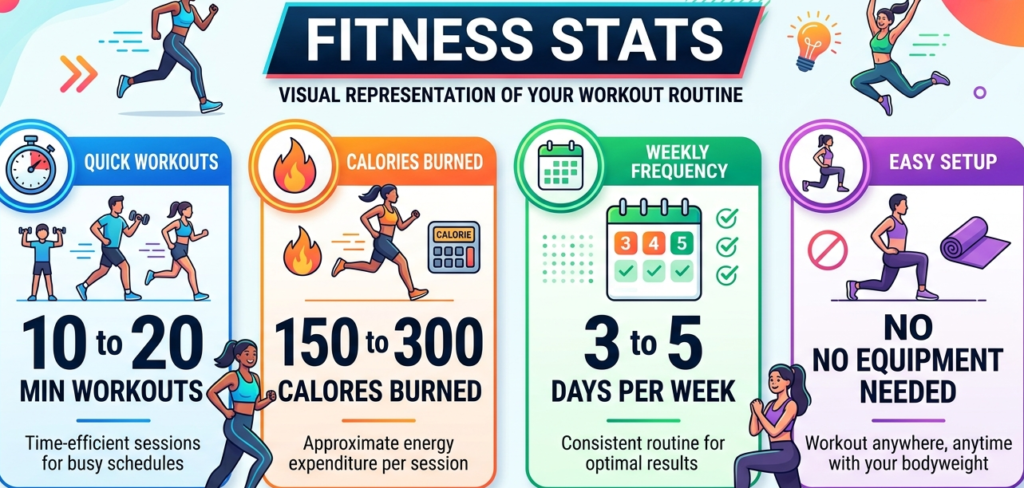
- Time-efficient workouts: You can complete a full routine in 10 to 20 minutes
- No gym required: Perfect for home workouts, office breaks, or travel
- Cost-effective fitness: No subscriptions or equipment purchases needed
- Flexible scheduling: Exercise whenever it fits your day
- Functional strength: Improves real-life movement and mobility
The Science behind Bodyweight Training
Bodyweight training uses your own weight as resistance. Movements like squats, push-ups, and lunges activate multiple muscle groups at once, making them highly efficient.
Key benefits include:
- Increased muscle endurance
- Improved balance and coordination
- Better cardiovascular health when done in circuits
- Reduced injury risk compared to heavy lifting
If done consistently, no-equipment workouts can deliver results comparable to traditional gym routines.
Best No-Equipment Exercises You Can Do Anywhere
Let’s break down the most effective exercises you can perform without any equipment. These form the foundation of a complete bodyweight workout routine.
1. Push-Ups
Push-ups are one of the best upper body exercises.
Targets: Chest, shoulders, triceps, core
How to do it: Keep your body in a straight line. Lower yourself until your chest is close to the floor. Push back up slowly.
Pro tip: Modify by doing knee push-ups if needed.
2. Squats
Squats are essential for lower body strength.
Targets: Quads, hamstrings, glutes
How to do it: Stand with feet shoulder-width apart. Lower your hips like you are sitting in a chair. Keep your chest up and knees aligned
Pro tip: Add a pause at the bottom for extra intensity.
3. Lunges
Lunges improve balance and leg strength.
Targets: Glutes, quads, hamstrings
How to do it: Step forward with one leg. Lower your back knee toward the ground. Push back to starting position
4. Plank
Planks are excellent for core stability.
Targets: Core, shoulders, back
How to do it: Keep your body straight from head to heels. Engage your core. Hold the position without sagging
5. Burpees
Burpees combine strength and cardio.
Targets: Full body
How to do it: Start standing. Drop into a squat and place hands on the floor. Jump back into a plank. Return to standing and jump
Pro tip: This is one of the best fat-burning exercises without equipment.
6. Mountain Climbers
Great for cardio and core engagement.
Targets: Core, legs, shoulders
How to do it: Start in a plank position. Alternate bringing knees toward your chest quickly
7. Glute Bridges
Perfect for strengthening the lower body.
Targets: Glutes, lower back
How to do it: Lie on your back with knees bent. Lift your hips toward the ceiling. Squeeze your glutes at the top
8. Jump Squats
Add explosive power to your routine.
Targets: Legs, glutes
How to do it: Perform a squat. Jump upward explosively. Land softly and repeat
15-Minute No-Equipment Workout Routine
If you are short on time, this quick workout is perfect.
- Duration: 15 minutes
- Format: Circuit training
- Perform each exercise for 40 seconds, rest for 20 seconds: Push-ups, Squats, Mountain climbers, Lunges and Plank. Repeat the circuit 3 times.
This type of high intensity interval training at home is extremely effective for burning calories and improving endurance.
10-Minute Office Workout Routine
Even at work, you can stay active.
Discreet exercises for the office:
Discreet exercises for office people are given as below:
- Chair squats
- Desk push-ups
- Standing lunges
- Calf raises
- Wall sit
These micro workouts help combat the negative effects of prolonged sitting, which is a major concern for professionals.
Morning vs Evening Workouts – What Works Best?
There is no one-size-fits-all answer. The best time to work out is the time you can stay consistent.
Morning workouts:
- Boost energy for the day
- Improve focus and productivity
- Easier to build a habit
Evening workouts:
- Help relieve stress
- Improve sleep quality
- Allow more flexibility
For busy professionals, consistency matters more than timing.
Tips to Stay Consistent with Your Fitness Routine
Staying consistent is often harder than starting. Here are practical strategies:
1. Schedule Your Workouts: Treat exercise like an important meeting. Block time in your calendar.
2. Start Small: Even 10 minutes a day can make a difference.
3. Use Habit Stacking: Pair your workout with an existing habit, like after brushing your teeth.
4. Track Progress: Keep a simple log of your workouts to stay motivated.
5. Remove Barriers: Lay out your workout clothes in advance.
Common Mistakes to Avoid
Even simple workouts can be ineffective if done incorrectly.
- Skipping warm-ups
- Poor form
- Doing the same routine every day
- Ignoring rest and recovery
- Overtraining without proper nutrition
Avoiding these mistakes will help you get better results faster.
How to Progress Without Equipment
You can still challenge yourself without weights.
Ways to increase difficulty:
Ways to increase difficulty are given as below:
- Increase repetitions
- Slow down movements
- Add pauses
- Try single-leg variations
- Reduce rest time
For example, progress from standard push-ups to decline push-ups or one-arm push-ups over time.
Benefits of No-Equipment Workouts for Mental Health
Fitness is not just physical. It has powerful mental benefits too.
- Reduces stress and anxiety
- Improves mood
- Boosts confidence
- Enhances focus and productivity
For professionals dealing with high-pressure environments, exercise acts as a natural stress reliever.
Nutrition Tips to Support Your Fitness Goals
Exercise alone is not enough. Nutrition plays a key role.
Simple guidelines:
Simple guidelines to support fitness goals are given as below
- Eat balanced meals with protein, carbs, and healthy fats
- Stay hydrated throughout the day
- Avoid excessive processed foods
- Include fruits and vegetables
- Do not skip meals
Travel-Friendly Workouts
Frequent travel can disrupt your routine. No-equipment exercises solve this problem. You can work out in Hotel rooms, Airports, Parks and small spaces as well. A simple 10-minute routine can keep you on track even during busy trips.
Sample Weekly No-Equipment Workout Plan
Here is a simple plan you can follow:
- Day 1: Full body workout
- Day 2: Cardio and core
- Day 3: Rest or light stretching
- Day 4: Lower body focus
- Day 5: Upper body focus
- Day 6: HIIT workout
- Day 7: Rest
This structure ensures balanced fitness and recovery.
Informative Fitness Stats for Busy Professionals
Here is a quick, data-driven overview to help you understand how effective no-equipment workouts can be. These stats are based on widely accepted fitness research and industry benchmarks.
| Category | Statistic | What It Means for You |
| Workout Duration | 10 to 20 minutes per session | Short workouts can still deliver strong results when done consistently |
| Calories Burned (HIIT) | 150 to 300 calories in 15 minutes | High-intensity bodyweight workouts are efficient for fat loss |
| Muscle Activation | Up to 8 major muscle groups per exercise | Compound movements like squats and push-ups save time |
| Weekly Recommendation | 150 minutes moderate or 75 minutes intense activity | You can split this into small daily sessions |
| Strength Gains | Noticeable improvement in 3 to 4 weeks | Consistency matters more than workout length |
| Equipment Needed | None | Eliminates cost and access barriers |
| Workout Frequency | 3 to 5 days per week | Ideal for maintaining balance and recovery |
| Productivity Boost | Up to 20 percent increase in focus after exercise | Helps improve work performance and mental clarity |
| Sitting Risk Reduction | Breaks every 30 to 60 minutes reduce health risks | Office workouts help counter long sitting hours |
| Adherence Rate | Higher for home workouts vs gym routines | Convenience increases consistency |
Final Thoughts
Staying fit does not require a gym, expensive equipment, or hours of free time. With the right mindset and a simple plan, no-equipment exercises can help busy professionals achieve their fitness goals efficiently. The key is consistency, not perfection. Start with short workouts, build momentum, and gradually increase intensity. Over time, these small efforts will lead to big results. If you are want to learn quick home workouts, no equipment fitness routines, or easy exercises for busy schedules, this approach is exactly what you need. Your health is one of your most valuable assets. Even in the busiest schedule, it deserves a place.
FAQs:
1. Can no-equipment exercises really build muscle?
Yes, bodyweight exercises can build muscle, especially for beginners and intermediate levels. Movements like push-ups, squats, and lunges create enough resistance to stimulate muscle growth when done consistently and with proper intensity.
2. How long should a no-equipment workout be?
Even 10 to 20 minutes is effective if done properly. Short, high-intensity workouts can deliver great results, making them perfect for busy professionals with limited time.
3. Can I lose weight with no-equipment workouts?
Absolutely. Combining bodyweight exercises with a healthy diet can help you burn calories and lose weight. High-intensity routines like burpees and mountain climbers are especially effective for fat loss.
4. How often should I work out without equipment?
Aim for at least 3 to 5 days per week. You can alternate between full-body workouts, cardio, and rest days to allow recovery while staying consistent.
5. What if I am a complete beginner?
Start with basic movements like squats, wall push-ups, and short planks. Focus on proper form and gradually increase intensity as your strength improves. Consistency matters more than difficulty at the beginning.
